Best Pocket Knife for Self-Defense? An Honest 2026 Guide
A pocket knife is a poor, legally risky choice for self-defense. Here's why, plus the safer options we recommend first and six reliable folding knives for everyday outdoor use.
HikingCare is reader-supported. When you buy through links on our site we may earn a commission at no extra cost to you. How we choose what to recommend.
🛡️ Quick answer
Is there a best pocket knife for self-defense? Not really. A knife is a poor, legally risky self-defense tool. Your safety is better served by awareness, avoidance and safer deterrents, with a small folding knife kept for everyday chores instead.
Below we explain why, walk through the knife laws that trip people up, and recommend six reliable, widely legal folding knives for outdoor utility, not confrontations.
*California Penal Code section 21510; National Park Service bear-spray guidance. See Sources.
Type “best pocket knife for self-defense” into a search bar and you’ll find long lists of blades that promise to keep you safe. We want to be honest with you before you buy any of them: a knife is one of the weakest tools for self-defense, and it can bring legal trouble you didn’t expect.
That doesn’t mean you should hike without a plan. It means the plan should start somewhere else: paying attention to your surroundings, avoiding trouble early, and carrying tools built for distance, like a loud alarm or pepper spray where it’s legal. A folding knife still earns a spot in your pocket, just for cutting cord, food and moleskin, not for confrontations.
In this guide we explain why a knife falls short as a self-defense tool, walk through how knife laws differ by state, city and park, and then recommend six dependable folding knives from established brands for everyday outdoor use. Think of it as advice from a hiking friend who cares more about your safety than about selling you a blade.
Here’s what you’ll get from this guide:
- Why a knife is a weak, legally risky choice for self-defense
- What actually helps: awareness, avoidance and safer deterrents
- How knife laws differ by state, city and national park
- The difference between pepper spray and bear spray, and when each is legal
- How to choose a reliable folding knife for everyday outdoor tasks
- Six established, widely legal EDC knives, picked for utility, not combat
Is a Pocket Knife Good for Self-Defense? The Honest Answer
Let’s answer the search query directly. If you came here looking for the best pocket knife for self-defense, the honest answer is that no ordinary pocket knife is a good choice for that job. A folding knife is a cutting tool. Using one against another person means fighting at arm’s length, and that is a dangerous, unpredictable place to be.
We’re not saying this to scare you away from carrying a knife. Most hikers already carry one, and a good folding knife is genuinely useful on the trail: cutting cord, slicing food, trimming moleskin, opening packages. We simply want you to buy it for those reasons, not as a self-defense plan.
If personal safety is what brought you here, keep reading. We cover what actually reduces your risk on a trail, the safer tools worth considering, and then six solid folding knives for the jobs a knife is genuinely good at.
This guide covers both sides of that coin. First, the honest limits of a knife as a self-defense tool, and the safer options we recommend instead. Second, the legal side, since knife rules shift from state to state and even city to city. By the end, you’ll know what to carry for safety, and which plain folding knife is worth carrying for everything else.
⚠️ A knife is not a safety plan
Relying on a blade for protection can give you false confidence. It can also turn a scary but survivable situation into a dangerous physical fight, or a legal problem, even when you were the one being threatened.
Why a Knife Is a Poor Self-Defense Tool
A few plain facts explain why we steer readers away from treating a knife as self-defense gear.
- It only works up close. A knife has no reach. To use one, someone would already need to be within arm’s length of you, which is the exact distance you want to avoid with a stranger who worries you.
- It can be taken from you. In a struggle, a knife can change hands. That risk is well known among self-defense instructors, and it is one reason many recommend distance-based tools instead.
- It raises the stakes fast. Pulling a blade can turn a tense but manageable moment into a life-threatening one for everyone involved, including you.
- It needs real training. Using any edged tool safely and effectively under stress takes practice most hikers never get around to.
- It carries legal weight. Even a justified act of self-defense with a knife can lead to a serious investigation, because the injuries a blade causes are hard to walk back.
None of this means you’re defenseless. It means your best tools are the ones that create distance and time: noticing trouble early, leaving before it escalates, and carrying a loud alarm or legal spray that works before anyone gets close enough to grab a blade.
The safest response to trouble is usually the one that gets you away from it fastest. A folding knife is a tool for chores, not a plan for danger.
Knife Laws Vary by State and City
Even if you only ever plan to use a knife for camp chores, the law still cares what you carry and how. The American Knife and Tool Institute (AKTI), a trade group that tracks knife legislation nationwide, notes that certain knives can be classified as weapons based on their mechanism, blade length or other terms, and that what counts as “concealed” also differs from state to state. Carrying the same knife can be a minor issue in one state and a serious charge in another.
Three things usually decide how a state or city treats a folding knife:
- Blade length. Many places exempt small, plain folding knives from weapon rules, often somewhere under 3 to 4 inches, but the exact cutoff and how it’s measured both vary.
- How it opens. A simple manual folder (thumb stud, flipper or nail nick) is treated very differently from an automatic knife, commonly called a switchblade, in most places. Assisted-opening knives, which need a manual push before a spring finishes the motion, are usually treated as manual knives under federal law, but a few states still draw their own lines.
- Whether it locks. Some cities and states treat a locking folder as closer to a fixed-blade knife than a simple pocketknife, which can change where you’re allowed to carry it.
Two real examples show how specific these rules get. California’s Penal Code section 21510 makes it a crime to carry, sell or transfer a switchblade with a blade of two inches or more. New York took the opposite path in 2019, when the state legislature removed “gravity knife” from its weapons law. Many ordinary one-hand-opening folders had been prosecuted under that old definition for years. The change means owning one is no longer automatically illegal there.
| Place | What the rule looks at | What we found |
|---|---|---|
| California | Blade type and length | Penal Code section 21510 bans carrying, selling or lending a switchblade with a blade of 2 inches or more |
| New York | Which knives count as a “weapon” | A 2019 law removed “gravity knife” from Penal Law 265.00, so many ordinary folders are no longer automatically illegal there |
| National parks | The law of the state the park sits in | Follows state law Federal rule 36 CFR 1.4 folds in whatever the surrounding state already bans |
| Cities and counties | Local ordinances on top of state law | Some add their own carry or length rules, so check the local code too, not just the state one |
📝 General information, not legal advice
We checked these rules in September 2026. Knife laws change often and vary by city as well as state. Before you carry, travel or fly with any knife, check your state’s current statute and, if you’re going somewhere new, that state’s rules too.
Do National Parks Have Their Own Knife Rules?
Mostly, no. National parks don’t write a separate knife law. Instead, federal rule 36 CFR 1.4 defines a “weapon” to include anything already prohibited by the law of the state where the park sits. A related rule, 36 CFR 2.4, prohibits carrying or possessing a weapon in violation of federal or state law. It also treats an unloaded weapon or blade as “ready for use” unless it’s cased, packed or stored in a way that prevents that.
In plain English: if your knife is legal where you live, and legal in the state the park sits in, it’s almost always fine on the trail. If it’s the kind of blade that’s restricted at home, a park inside that same state won’t make it legal. A state boundary can change the answer entirely, too. When you’re not sure, check the park’s website, or ask a ranger at the visitor center.
Flying to a trailhead adds one more rule that has nothing to do with state law. The Transportation Security Administration (TSA) does not allow knives of any kind in carry-on bags, only in checked luggage, and it asks travelers to sheathe or securely wrap sharp items so baggage handlers aren’t at risk. Plan to pack your knife in checked baggage, never a carry-on, whenever you fly to a hike.
Better Tools: Awareness, Avoidance and Safer Deterrents
If personal safety is genuinely on your mind, put your effort here first. None of these options need a blade, and most of them work at a distance, which is exactly what you want.
Situational awareness comes first
The Appalachian Trail Conservancy (ATC) calls situational awareness one of your best defenses on the trail. Its advice is simple. Know roughly where you are. Trust an uneasy gut feeling, even if you can’t explain it. Skip the earbuds so you can hear what’s around you, and avoid sharing your exact camp plans with strangers. If someone makes you uncomfortable, the ATC suggests saying you’re hiking with a group that’s catching up, then simply walking away. None of that costs anything, and it works before any tool ever needs to.
Personal safety alarms
A personal alarm is a small device that shrieks loudly when you pull a pin or press a button. Some models reach roughly 130 decibels. It doesn’t need aim, contact or training, just a hand near a clip on your pack strap or belt loop. The noise is meant to startle someone and draw attention from anyone nearby, which is exactly the kind of distraction that buys you time to get away.
Pepper spray, where it’s legal
Pepper spray, also called OC spray, is legal to carry in all 50 states, but the details differ. According to SABRE, a major pepper spray maker, New York limits canisters to 0.75 ounces and 0.7 percent strength. Purchases there must be in person, from a licensed dealer or pharmacist, and capped at two per person. Massachusetts also requires a license to sell or carry it, and buyers age 15 to 18 need a firearms ID card. Other states set their own limits on size or who can buy it. Check your state, and the state you’re traveling to, before you buy or pack one.
Bear spray is for bears only
Bear spray looks similar to pepper spray, but it isn’t the same product, and it isn’t a backup weapon against people. The National Park Service is direct about this: bear spray is not a repellant, and you should never spray it on people, tents or backpacks. It’s registered with the Environmental Protection Agency to stop a charging or aggressive bear. It’s meant for use at roughly 25 feet or more, not close use on a person. If you hike in bear country, carry it where you can reach it in two seconds. Keep it entirely separate from any human pepper spray you also carry.
🐻 Bear spray and pepper spray aren’t interchangeable
Bear spray is built and labeled for bears. Human pepper spray is built and labeled for people. Carrying both is fine. Using one in place of the other is exactly what the labels warn against.
How to Choose a Reliable Everyday-Carry Knife
Once you’ve put safety tools in their right order, a plain folding knife is still worth carrying for chores. Here’s what actually matters when you pick one.
Blade length
Shorter blades cause fewer legal questions. Most of the knives we recommend below carry a blade between 2.28 and 3.24 inches, and our smallest pick is smaller still. Staying compact keeps each one closer to “ordinary pocketknife” in most places. A shorter blade also does most camp chores just as well as a longer one: cutting cord, opening packaging, prepping food.
Opening style and lock
A manual folder opens with a thumb stud, flipper or thumb hole, using only the pressure of your hand. An assisted-opening knife adds a spring that finishes the motion after you start it. An automatic knife, or switchblade, opens fully at the push of a button instead. Manual knives face the fewest extra rules almost everywhere. That’s why every pick below opens by hand alone. A lock, such as a back lock, liner lock or Benchmade’s AXIS lock, then holds the blade open safely while you cut.
Steel and edge care
Budget steels like 8Cr14MoV sharpen quickly but need more frequent touch-ups. Premium steels like CPM-S30V, VG-10 and Sandvik 14C28N hold an edge longer and often resist rust better, for a higher price. Either way, plan to wipe your blade dry after wet use and sharpen it occasionally. A dull knife is more likely to slip than a sharp one.
Buy from an established brand
Established knife makers publish real specs, stand behind their products and sell replacement parts. Victorinox backs its knives with a lifetime warranty, and Benchmade offers a LifeSharp service program that sharpens and inspects its knives. That kind of support is a good sign you’re buying a tool built to last, not a knife made to look tough on a listing photo.
Our Top Picks: Reliable EDC Folding Knives for Outdoor Utility
We picked these six from published specs and manufacturer information, weighted toward modest blade length, manual opening and established brands. Every one is a plain utility folder, not a knife marketed for fighting. For legal deterrents and safer self-defense options, see the section above, not this list. For more on legal, sturdy walking sticks, see our guide to tactical hiking sticks and our list of the best tactical hiking sticks. Read more about how we pick gear on our methodology page.
| Knife | Blade length | Opening / lock | Best for |
|---|---|---|---|
| Victorinox Cadet Alox | Compact (46 g total) | Slip joint, no lock | Most widely accepted Everyday tools |
| Opinel No.08 | 3.3 in | Virobloc collar lock | Traditional utility knife |
| Spyderco Dragonfly 2 | 2.28 in | Manual, back lock | Smallest and lightest |
| Benchmade Bugout 535 | 3.24 in | Manual, AXIS lock | Lightest full-size blade |
| CRKT Drifter | 2.88 in | Manual, liner lock | Budget-friendly |
| Kershaw Skyline | 3.1 in | Manual, liner lock | Slim daily carry |
🔧 Most widely accepted pick
Victorinox
Victorinox Cadet Alox Swiss Army Knife
A slim, non-locking Swiss Army knife that raises the fewest legal questions here.
The Cadet is a classic Swiss Army knife, not a “tactical” tool, and that’s exactly its appeal. Its main blade is a plain, non-locking spear point, the kind of simple slip-joint pocketknife most places treat as ordinary cutlery. Alongside the blade you get a can opener, screwdrivers, a wire stripper and a nail file, so it earns its space on chores.
- Non-locking main blade keeps it in the least-regulated knife category almost everywhere
- 9 useful tools in one slim, 46-gram body
- Alox aluminum scales resist scratches and wear
- Swiss-made with a Victorinox lifetime warranty
| Weight | 46 g (1.6 oz) |
|---|---|
| Functions | 9 |
| Handle | Alox (aluminum) |
| Blade lock | None (slip joint) |
Best for: hikers who want the most widely accepted knife on this list for everyday chores. Its blade doesn’t lock open, so skip it for hard, repeated cutting.
🛒 Buy from Amazon Check colors and today’s price on Amazon.
🪵 Best traditional utility knife
Opinel
Opinel No. 08 Stainless Steel Folding Knife
A simple French utility knife with a locking collar and a design that’s nearly a century old.
The No.08 is Opinel’s most popular size, built for camp chores, not confrontations. Its stainless steel blade locks open with the Virobloc collar, a metal ring you twist to secure the blade for use and again to lock it shut for carry. The beechwood handle stays light and comfortable through long cutting jobs like food prep or trimming cord.
- Virobloc collar locks the blade both open and closed
- Stainless blade resists rust better than Opinel’s carbon-steel version
- Comes with a faux-leather belt sheath
- Simple, inexpensive design refined since 1955
| Blade length | 8.5 cm (about 3.3 in) |
|---|---|
| Steel | Stainless, 55–57 HRC |
| Handle | Beechwood |
| Lock | Virobloc collar |
Best for: campers and hikers who want an honest, traditional utility knife. Twist the collar fully closed before you cut, since an unlocked Opinel blade can fold if you push too hard.
🛒 Buy from Amazon Check today’s price on Amazon.
🪶 Smallest and lightest
Spyderco
Spyderco Dragonfly 2 Lightweight Folding Knife
A tiny, feather-light folder that still holds a real lock.
The Dragonfly 2 is one of the smallest knives Spyderco makes, with a 2.28-inch blade and a 5.58-inch overall length. Its FRN handle keeps weight down, and a round Spyderco thumb hole opens the blade with one hand, no spring assist involved. A back lock then holds the blade firmly open for cutting.
- Blade under 2.5 inches, useful where local length limits are strict
- Back lock holds the blade open securely
- FRN handle is very light for all-day carry
- Full-flat-ground VG-10 steel cuts cleanly
| Blade length | 2.28 in |
|---|---|
| Overall length | 5.58 in |
| Steel | VG-10 |
| Handle / lock | FRN, back lock |
Best for: hikers who want the smallest, lightest knife here, or who hike somewhere with a strict blade-length rule. It’s too small for heavy carving or bushcraft chores.
🛒 Buy from Amazon Check colors and today’s price on Amazon.
🎒 Lightest full-size blade
Benchmade
Benchmade Bugout 535 Folding Knife
An ultralight backpacking knife with Benchmade’s ambidextrous AXIS lock.
Benchmade built the Bugout for hikers who count every ounce. At 1.85 ounces it barely registers in a pocket, yet the blade is a full 3.24 inches of CPM-S30V stainless steel, an alloy that holds an edge well on long trips. The AXIS lock opens and closes with one hand from either side, and it’s a mechanical lock, not a spring assist.
- Only 1.85 oz, among the lightest full-size folders available
- AXIS lock is ambidextrous and easy to check by eye
- CPM-S30V blade steel holds an edge through long trips
- Made in the USA, with Benchmade’s LifeSharp service program
| Blade length | 3.24 in |
|---|---|
| Weight | 1.85 oz |
| Steel | CPM-S30V (58–60 HRC) |
| Handle / lock | Grivory, AXIS lock |
Best for: backpackers who want a full-size blade at trail-runner weight. At 3.24 inches, check local blade-length rules before you carry it concealed in a stricter city.
🛒 Buy from Amazon Check today’s price on Amazon.
💰 Budget-friendly pick
CRKT
CRKT Drifter Folding Knife
An affordable liner-lock folder built for daily chores.
The Drifter is CRKT’s budget-friendly everyday carry knife, with a 2.88-inch plain-edge blade in 8Cr14MoV steel and a titanium nitride coating that helps resist corrosion. A thumb stud opens the blade by hand, and a liner lock holds it open. Textured G10 scales and a pocket clip make it easy to carry and find quickly.
- Budget-friendly price for a locking EDC folder
- Titanium-nitride-coated blade resists corrosion
- G10 handle scales grip well when hands are wet or gloved
- Reversible pocket clip for quick, secure carry
| Blade length | 2.88 in |
|---|---|
| Overall length | 6.50 in |
| Weight | 2.40 oz |
| Handle / lock | G10, liner lock |
Best for: hikers who want a dependable locking folder without spending much. It’s a working knife, so expect to sharpen it more often than premium steels.
🛒 Buy from Amazon Check today’s price on Amazon.
📎 Slim daily carry
Kershaw
Kershaw Skyline Folding Knife
A slim, all-manual flipper with no spring assist to think about.
The Skyline is built thin enough to disappear in a pocket, with textured G10 scales and a 3.1-inch Sandvik 14C28N blade. Kershaw made it a manual-open knife: you swing the blade out yourself with the flipper tab or thumb stud. There’s no assisted-opening spring, which keeps it clear of the extra rules some places apply to assisted knives. A liner lock then holds the blade firm once it’s open.
- Manual opening only, with no spring assist to complicate local rules
- Sandvik 14C28N steel resists corrosion and holds an edge
- Slim G10 handle carries flat and light
- Reversible pocket clip for tip-up or tip-down carry
| Blade length | 3.1 in |
|---|---|
| Weight | 2.5 oz |
| Steel | Sandvik 14C28N |
| Handle / lock | G10, liner lock |
Best for: hikers who want a slim, no-frills manual folder for daily tasks. Its steel resists rust better than premium powder steels, but won’t hold an edge quite as long.
🛒 Buy from Amazon Check today’s price on Amazon.
Prices and stock change often, so check each listing before you buy. As an Amazon Associate, HikingCare earns from qualifying purchases, at no extra cost to you.
Carrying a Knife Safely and Legally on the Trail
How you carry a knife matters almost as much as which one you buy. A few habits keep you on the right side of both safety and the law.
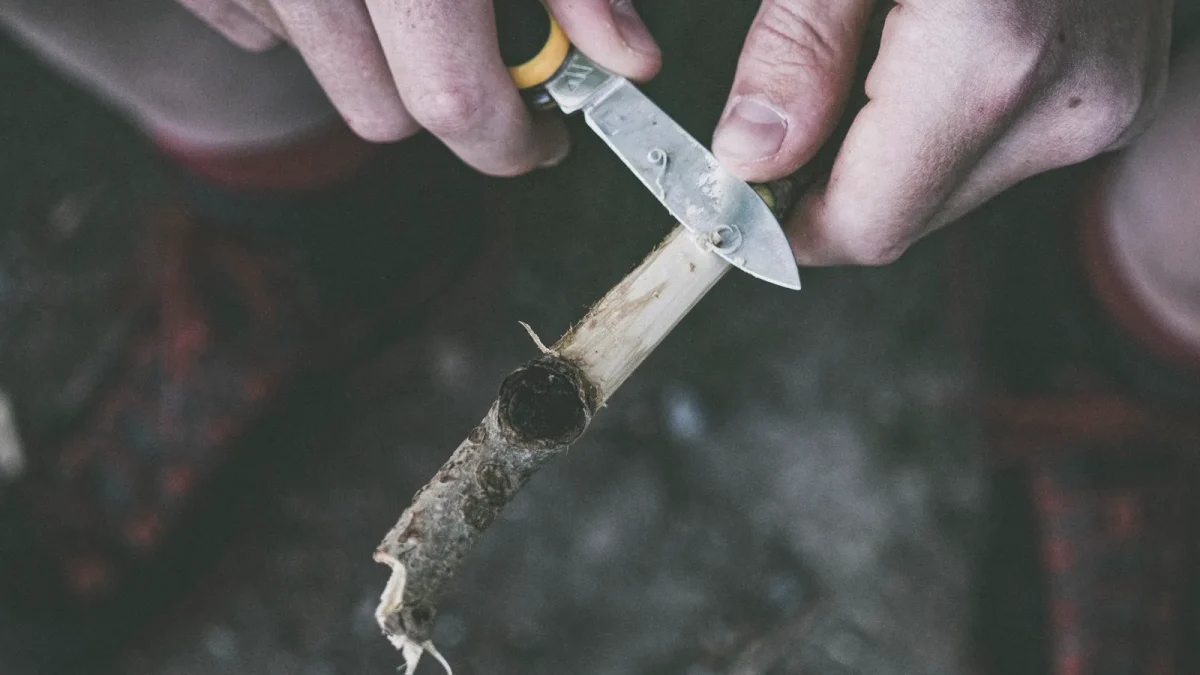
- Keep it closed until you need it. A folded, locked blade in your pocket or on your belt draws no attention and causes no accidents.
- Clip it where you can see it. A pocket clip or belt sheath keeps your knife secure and easy to find, instead of loose at the bottom of a pack.
- Don’t open it around other people unless you’re using it. Even an innocent utility knife can alarm someone if it appears during a tense moment.
- Check state and local rules before you travel. A knife that’s fine at home can be a problem after a flight or a long drive across state lines.
- Pack it in checked luggage when you fly. The TSA doesn’t allow knives in carry-on bags, so plan ahead rather than finding out at the checkpoint.
- Dry and store it clean. Wipe the blade after wet use, and store it dry so it doesn’t rust or stick.
💡 Build a safer trail kit
Pair a plain utility knife with a personal alarm clipped to your pack strap, legal pepper spray if you choose to carry it, and a shared route with someone at home. That combination covers far more real situations than a blade alone ever could.
Common Mistakes (and How to Fix Them)
Most problems with knives and trail safety come from a handful of avoidable mistakes. Here’s each one, and the simple fix.
1. Treating a knife as your safety plan
❌ The mistake: buying a blade and stopping there, as if that alone keeps you safe.
✅ The fix: put awareness, avoidance, a shared route and a legal alarm or spray first. Keep the knife for chores.
2. Picking a knife because it looks aggressive
❌ The mistake: choosing a blade marketed with combat language, skull logos or “tactical” branding.
✅ The fix: pick a plain, established-brand utility folder. It works just as well for chores and raises far fewer questions.
3. Not checking state and city rules before you travel
❌ The mistake: assuming a knife that’s legal at home is legal everywhere else.
✅ The fix: check the destination state’s knife law, and its cities, before a road trip or flight, not after you arrive.
4. Assuming national parks are exempt from state law
❌ The mistake: thinking federal land ignores whatever the surrounding state bans.
✅ The fix: remember that 36 CFR 1.4 folds the state’s weapon law into the park. Check both before your trip.
5. Reaching for bear spray on a person
❌ The mistake: treating bear spray as a stand-in for human pepper spray.
✅ The fix: carry a separate, human-labeled pepper spray if that’s your choice, and keep bear spray strictly for bears.
6. Buying a locking or assisted knife without checking the extra rules
❌ The mistake: not realizing that a lock or an assisted-opening spring can change how a place treats your knife.
✅ The fix: choose a manual, non-assisted model like the picks above, and still check your local rules.
Pro Tips for Trail Safety and Everyday Carry
These small habits cost little, and each one adds real peace of mind. None of them need a blade.
- Clip a personal alarm somewhere you can reach it one-handed, such as a shoulder strap, so it’s ready instantly.
- Share your route and expected return time with someone before every hike, even a short one.
- Trust your gut and leave early. Walking away from an uneasy situation costs nothing and beats confronting it.
- Keep your knife sharp and clean. A sharp blade is safer to use than a dull one, because it needs less force.
- Practice with any spray you carry in daylight at home first, so the safety catch and aim aren’t a surprise later.
- Store bear spray where you can reach it in seconds, not buried at the bottom of a pack.
- Re-check knife and spray laws before a road trip or flight, not after you arrive.
- Keep your phone charged and offline maps saved. A dead phone can turn a small problem into a bigger one.
- Hike popular trails during daylight hours if solo safety is a real worry for you, since busier trails mean more people nearby.
Awareness is free, it weighs nothing, and it works before any tool ever needs to.
Real-World Examples: Three Common Choices
These are composite examples built from patterns hikers commonly share in trail forums, reviews and online communities. They’re not individual testimonials, but they show how different needs lead to different choices.
What these three have in common: each one matched the tool to the actual problem. The solo hiker leaned on awareness and an alarm, not a blade. The road-tripper treated the law as part of trip planning, not an afterthought. The family kept a bear deterrent for bears and nothing else. None of them needed a knife for protection, because none of them were using a knife for protection in the first place.
Frequently Asked Questions
Is a pocket knife good for self-defense?
No, generally not. A knife only works at very close range, it can be taken from you in a struggle, it can escalate a confrontation, and using one carries real legal risk. Awareness, avoidance and distance-based tools work better for most hikers.
Are pocket knives legal to carry while hiking?
Plain folding utility knives are legal in most places, but blade length, whether the blade locks and how it opens can all change the answer. Rules vary by state and city, so check both before you carry one somewhere new.
Do national parks have their own knife rules?
Not usually a separate one. Federal rule 36 CFR 1.4 folds in whatever weapon law the surrounding state already has. If your knife is legal in that state, it’s almost always fine in the park too.
Is pepper spray a better self-defense option than a knife?
For most people, yes. Pepper spray works at a distance and doesn’t require the same close contact or physical struggle a knife does. It’s legal in all 50 states, though size, strength and purchase rules vary, so check your state first.
Can I use bear spray on a person?
No. Bear spray is registered with the EPA and labeled specifically for use on bears. The National Park Service says plainly not to spray it on people, tents or backpacks.
What is the best pocket knife for hiking if not for self-defense?
A small-to-midsize manual folder from an established brand, sized for chores rather than confrontation. Our six picks above, from Victorinox, Opinel, Spyderco, Benchmade, CRKT and Kershaw, all fit that description.
Your Trail Safety and Knife-Buying Checklist
Work through this list before your next hike, and again before you travel somewhere new with any knife or spray. It moves from safety priorities to legal checks to the knife itself.
Tap each item as you complete it. Your progress is saved in this browser.
- Put awareness, avoidance and communication first, ahead of any gear
- Share your route and expected return time before you leave
- Clip a personal alarm somewhere you can reach with one hand
- Check your state’s pepper spray rules before you buy or travel with it
- Keep bear spray separate from any human pepper spray, and never aim it at a person
- Check your state and city knife laws before you carry
- Check national park rules, which generally follow the law of that state
- Choose a manual-opening, modest-length folding knife from an established brand
- Pack any knife in checked luggage, never a carry-on, when you fly
- Keep your knife for chores: food prep, cordage and small repairs
The Bottom Line
There is no genuinely good pocket knife for self-defense, because a knife needs close range, training and a legal risk most hikers shouldn’t take on. What actually helps is free or nearly free: awareness, avoidance, a shared route and, where you choose to carry them, a personal alarm or legal pepper spray.
Once your safety plan is in order, a plain, established-brand folding knife still earns its place in your pocket for everyday chores. Choose one with a modest blade length and a manual, non-assisted lock, and check the rules wherever you carry it.
🛡️ Build a safer trail safety kit
Plan your safety priorities and the rest of your gear with our free tools. No sign-up needed.
Keep reading: our full guide to tactical hiking sticks, the best tactical hiking sticks and the 10 essentials every hiker needs.
Sources
- American Knife and Tool Institute: State knife laws
- California Penal Code section 21510 (switchblade knives)
- New York State Senate: 2019 gravity knife legislation (S3898)
- 36 CFR 1.4: Definitions (National Park Service regulations)
- 36 CFR 2.4: Weapons, traps and nets
- TSA: What can I bring? Knives
- National Park Service, Grand Teton: Bear spray guidance
- Appalachian Trail Conservancy: Safety and crime prevention
- SABRE: Pepper spray laws by state
- Victorinox: Cadet Alox specifications
- Opinel: N°08 Stainless Steel specifications
- Benchmade: Bugout 535 specifications
- CRKT: Drifter (Liner Lock) specifications
Facts checked in September 2026. Laws, travel rules and products change, so confirm details before you carry, fly or buy.
You may also like
Best Paracord Bracelet (2026): Cord Types, Weaves and a DIY Guide
The best paracord bracelet starts with the right cord. Learn what Type III 550 really means, how it compares with 325 and…
The Best 2-Person Backpacking Tents for 2026
The best 2-person backpacking tent balances weight per person, foot-end width and door count, not just floor area. See six tents compared,…

How to Avoid Ticks While Hiking (2026 CDC-Based Guide)
Follow CDC guidance to avoid ticks while hiking: permethrin-treated clothing, EPA-registered repellents, trail habits, tick checks, correct removal steps and when to…

Get better at hiking.
Practical hiking tips, gear guides, trail advice and outdoor stories, delivered occasionally. No spam, unsubscribe any time.