OGIO Alpurist Backpack Review: Is It Still Sold in 2026?
We could not confirm the OGIO Alpurist is still sold. Its trademark is inactive and it's absent from OGIO's current lineup. Here is what we verified, plus three current hiking-and-travel backpacks worth considering instead.
HikingCare is reader-supported. When you buy through links on our site we may earn a commission at no extra cost to you. How we choose what to recommend.
🔍 Quick answer
Looking for an honest OGIO Alpurist backpack review before you buy one? We could not confirm the Alpurist is still sold. Its OGIO trademark has sat inactive for years, and no current OGIO catalog lists a backpack by that name.
This review lays out exactly what public trademark records and OGIO’s current site show, what we could not verify, and three current hiking-and-travel backpacks with confirmed specs you can look at instead.
*From USPTO trademark records and OGIO’s current backpacks page. See Sources.
If you searched for an OGIO Alpurist backpack review, you likely found the same thin results we did: one other older review site, a handful of pages repeating the same unsourced numbers, and nothing from OGIO itself.
That pattern is worth taking seriously before you spend money on a specific model name. So we did the digging that a normal product page would save you: we checked OGIO’s current backpack catalog, searched federal trademark records for the “Alpurist” name, and looked for the product on Amazon, REI and independent gear-review sites.
Here is what makes this guide different. We will not repeat specific numbers just because other pages list them. We will tell you exactly what we could confirm, what we could not, and which hiking-and-travel backpacks solve the same problem today, with specs we checked ourselves.
Here’s what you’ll get from this guide:
- A straight answer on whether the OGIO Alpurist is still sold anywhere
- What federal trademark records actually show about the Alpurist name
- An honest explanation of why we won’t repeat the specs some sites list
- Three verified hiking-and-travel backpacks you can buy new right now
- A side-by-side comparison table of those three alternatives
- What to check before buying any “hiking meets travel” backpack
Is the OGIO Alpurist Backpack Still Sold? The Short Answer
As of September 2026, we could not find the OGIO Alpurist for sale anywhere. OGIO’s own site lists roughly 30 current backpacks, across lines like Rise, Renegade, Alpha, Axle and Pace Pro. None of them is called Alpurist.
We also checked Amazon, REI and eBay for a current listing, and searched gear-review databases like Trailspace for an owner review. We found none. The only pages that mention the Alpurist by name are a small number of thin content sites and the old hikingcare.com page we are rebuilding here.
| Question | What we found |
|---|---|
| Listed on OGIO’s current site? | No Not among OGIO’s roughly 30 current backpacks |
| Federal trademark status? | Inactive: filed 1990, marked “continued use not filed within grace period, un-revivable” |
| Sold new by major retailers? | No listing found at REI, Backcountry, Dick’s or Amazon |
| Independent gear reviews? | None found on Trailspace, OutdoorGearLab or similar sites |
| What we could confirm is real | A 1990 US trademark filing by OGIO International, Inc. for the name “Alpurist” |
⚠️ Be skeptical of specs with no source
Several pages list precise numbers for the Alpurist, like a 75-liter capacity and a 5.5-pound weight, without linking to OGIO, a retailer or a gear-review site. We could not verify those figures against any source we trust, so we are not repeating them as fact in this guide. Treat any page that states specs with zero citation as a starting point for more digging, not a final answer.
What Public Records Show About the Alpurist Name
Federal trademark records give us one solid, checkable fact. On November 19, 1990, OGIO International, Inc. filed a US trademark application for “ALPURIST,” serial number 74116284, in the goods category that covers backpacks, luggage, and bags. That filing is real and searchable today.
What the record also shows is that the trademark’s current status is inactive. Trademarkia lists it as “continued use not filed within grace period, un-revivable,” which means OGIO never filed the paperwork needed to keep the mark active long-term, and it cannot be revived under that filing. That does not prove OGIO stopped selling the product on a specific date. It does tell us the company stopped treating the name as a protected, active brand asset.
Put together, this points to a real product name from OGIO’s early catalog, likely dating to the early-to-mid 1990s given the filing date, that has since fallen out of the lineup. OGIO was a younger company then, before it became known mainly for gaming, golf and everyday-carry bags. A “highly technical internal framed backpack” line would fit a company still finding its footing in the outdoor space.
A product name that once had a real trademark is not proof the product is still made today. Trademarks lapse. Catalogs change. Only a current listing proves current availability.
We looked for the specific specs that circulate online, capacity, weight, maximum load and color options, in OGIO’s own archives, in the Wayback Machine’s indexed snapshots of older OGIO pages, and in gear-review databases. None of those searches turned up a primary source. That is why the rest of this guide focuses on what a pack in this category should offer today, illustrated with three current backpacks we could verify completely.
Capacity: What a Hiking-and-Travel Hybrid Pack Should Hold
“Hiking, trekking and travel” packs, the category the Alpurist trademark filing suggests it belonged to, typically run from about 40 to 75 liters. That is a wide range, so it helps to match the number to the trip.
A carry-on-focused travel pack around 40 to 46 liters is built to meet most airlines’ cabin-bag rules while still holding a week of clothes and a laptop. A mid-size pack around 55 to 65 liters suits multi-week trips or light backcountry use, where you need room for a sleeping bag or cold-weather layers. Anything from about 65 to 75 liters-plus is aimed at longer treks, colder climates or travelers who check a bag and want maximum room.

| Trip type | Typical capacity | Why |
|---|---|---|
| Carry-on city travel, up to 2 weeks | 40-46L | Fits most airline cabin-bag limits |
| Multi-week travel or light trekking | 55-65L | Most common Room for layers and gear without checking a bag |
| Long treks, cold climates, checked bag | 65-75L+ | Space for a sleeping bag, bulky layers or shared gear |
💡 Weigh your gear before you pick a liter count
Liters only tell half the story. Use our free Hiking Gear Planner to list what you’ll actually carry, then match that list to a capacity instead of guessing.
Organization: What to Look For in a Hybrid Pack
Good organization is what separates a pack that feels calm from one that feels like a laundry bag. Look for a few specific features rather than just “lots of pockets.”
A front panel that unzips like a suitcase, sometimes called clamshell or duffel-style access, lets you see and reach everything without digging from the top. The Osprey Farpoint 70 and Sojourn Porter 46 covered later in this guide both open this way, and it is now standard on most dedicated travel packs. A separate padded laptop or tablet sleeve matters if you plan to work or study while you travel. A detachable daypack, like the 15-liter piece that zips off the Farpoint 70, gives you a second bag for day trips without carrying your whole load.
Lockable zipper pulls are a small feature that matters more than it sounds. They will not stop a determined thief, but they add a layer of security in hostels, on trains and at airports. Compression straps that cinch the outside of the pack keep a half-full bag from shifting and help it slide into overhead bins or storage lockers.
ℹ️ Front-loading versus top-loading
Technical trekking packs, like the Gregory Baltoro 65 in this guide, often keep some top-loading design because it seals out weather better on multi-day trips. Dedicated travel packs favor front-loading because you rarely need to keep rain out of a hotel-room floor.
Comfort and Fit
Comfort on a hiking-and-travel hybrid pack depends on how much real trekking it is built for, not just how much padding it has. A pack meant mainly for trekking usually has an adjustable torso length, a structured frame and a hip belt built to carry real weight on your hips instead of your shoulders. The Gregory Baltoro 65 in this guide is a good example, with a frame and hip belt system built for multi-day loads.
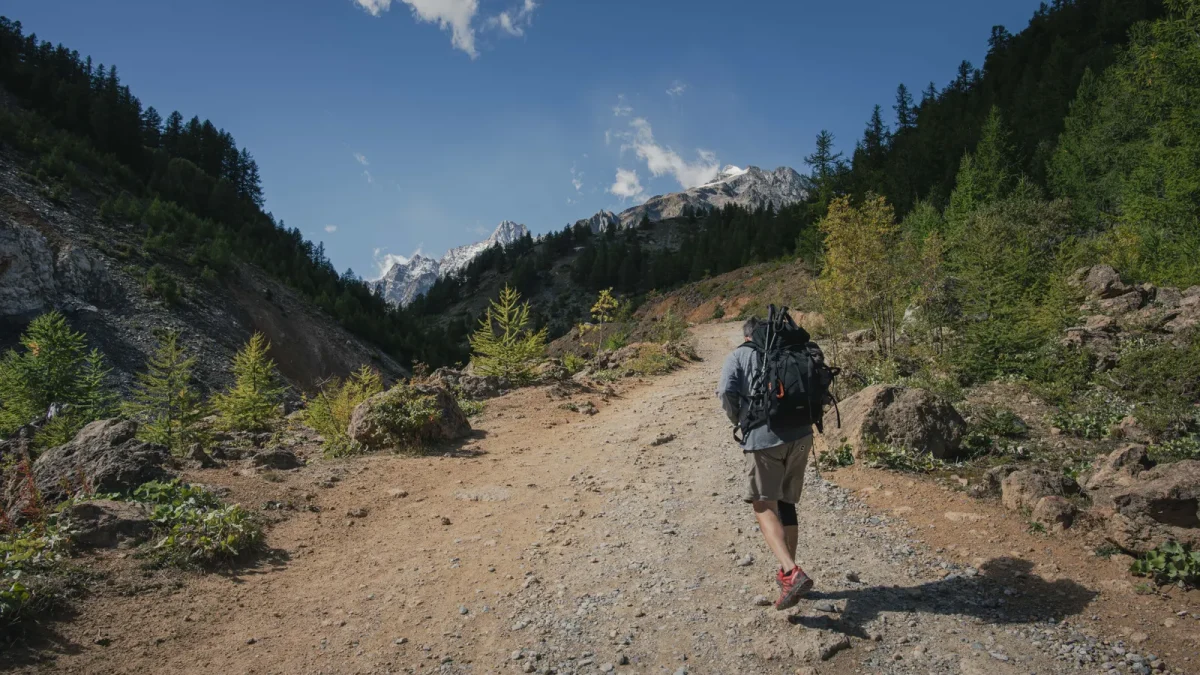
A pack built mainly for travel, like the Osprey Sojourn Porter 46, trades some of that structure for a slimmer profile that is easier to carry through a train station or stow under a seat. It still has padded straps and a hip belt, but the frame is lighter, because it is not expected to carry 40-plus pounds up a mountain.
Hybrid packs like the Osprey Farpoint 70 sit in between. They borrow real backpacking features, an adjustable torso and a load-bearing hip belt, and pair them with travel-friendly extras like lockable zips and a detachable daypack. If you genuinely plan to hike multi-day trails with the pack, prioritize torso adjustability and a real hip belt over sleek looks.
Whatever you choose, try the pack loaded before you commit. A hip belt that feels fine empty can dig in once you add 25 or 30 pounds of gear.
Travel Pack or Trekking Pack? Why the Difference Matters
The words “hiking,” “trekking” and “travel” get combined a lot in product names, including in the Alpurist’s own trademark filing. But the packs behind those words usually lean one way.
A trekking-first pack is built around a suspension system: a frame, a structured hip belt and a back panel designed to move weight off your shoulders on long, uneven days. It usually top-loads or offers multiple access points, has external straps for a sleeping pad or trekking poles, and skips features that only matter in cities, like a laptop sleeve.
A travel-first pack is built around fitting airline rules and city logistics. It usually opens like a suitcase, has a padded laptop compartment, and keeps its harness light or even stowable, since you might check it rather than wear it for miles.
A true hybrid tries to do both without fully excelling at either. That is a reasonable trade-off if your trip genuinely mixes flights, trains and a few days of real trail time. It is the wrong choice if 90% of your trip is one or the other; in that case, a dedicated pack in that category will almost always carry, organize or pack down better.
✨ Ask this one question first
Before you shop, ask: will this pack spend more nights on a hostel floor or more days on a trail? Let the honest answer, not the marketing category, decide whether you want a travel pack, a trekking pack or a genuine hybrid.
Who a Pack Like This Suits
We cannot tell you who the Alpurist specifically suited, since we cannot confirm its real specs or even a production date range. What we can say is who a modern hiking-and-travel hybrid pack in the 46- to 75-liter range generally fits.
This style of pack tends to suit long-trip travelers: study-abroad students, gap-year backpackers and multi-country trips where you will use trains, buses and the occasional overnight hike or day hike from a base. It suits people who want one bag for the whole trip rather than a suitcase plus a separate daypack, and who are willing to accept a pack that is merely good at trekking rather than excellent, in exchange for travel convenience.
It suits people less well if they need a pack for serious multi-day backcountry trips with a tent and stove, where a dedicated trekking pack’s suspension and pockets earn their keep, or if they mostly need a simple carry-on for short city trips, where a smaller, lighter travel pack is easier to live with.
Why We Can’t Give the Alpurist a Pros-and-Cons Verdict
A responsible pros-and-cons list has to rest on confirmed information. For the Alpurist, we do not have that. We have one real fact, a 1990s trademark filing, and a set of numbers on other websites that we cannot trace to OGIO, a retailer or an independent reviewer.
✨ What’s confirmed
OGIO International, Inc. filed a real US trademark for “Alpurist” in 1990, in the backpacks and bags category. That trademark is now inactive. OGIO’s current site does not list a product by that name.
⚠️ What’s not confirmed
Any specific capacity, weight, maximum load, price, color option or feature list attributed to the Alpurist. We found no manufacturer page, retailer listing, archived spec sheet or independent review that we could use as a source for these details.
Rather than guess, we are pointing you toward three current packs, covered next, that we could verify completely: real listings, real specs, real availability. If you already own an Alpurist and it works for you, that is great. This section is about what we can responsibly tell a new buyer, not about whether your existing pack is good.
3 Hiking-and-Travel Backpacks You Can Buy Today
We picked these three because they cover the range this category usually spans, from a carry-on-first travel pack to a genuine hybrid to a technical trekking pack. All three are currently sold new, with real listings we checked this session. Specs come from the manufacturer or retailer page. Nobody paid for a spot on this list.
🧳 Best true hybrid
Osprey
Osprey Farpoint 70L Men’s Travel Backpack
A 55-liter main pack plus a 15-liter detachable daypack, built for flights and trails.
The Farpoint 70 is the closest current match to what a “hiking, trekking and travel” pack should be. It front-loads like a suitcase for hostel and hotel life, but keeps a real LightWire suspension and adjustable torso for the days you actually hike.
- Detachable 15L daypack for day trips or errands
- LightWire frame and ErgoPull hip belt for real load support
- StraightJacket compression straps keep a half-full pack tidy
- Lockable zipper pulls on the main compartment
| Capacity | 70L total (55L pack + 15L daypack) |
|---|---|
| Weight | About 5.4 lb (main pack) |
| Dimensions | 27 x 14 x 9 in |
| Frame | LightWire suspension, adjustable torso |
| Access | Front panel, suitcase-style |
Best for: travelers who want one bag for flights, trains and the occasional multi-day hike. Not built for serious backcountry loads over about 35 pounds.
🛒 Buy from Amazon Check today’s price and colors on Amazon.
🏔️ Best for real trekking
Gregory
Gregory Baltoro 65L Backpacking Pack
A technical trekking pack with a foamless FreeFloat suspension and three ways to load gear.
If your trip is mostly trail with travel as the connector, the Baltoro 65 makes more sense than a travel-first hybrid. Its suspension and hip belt are built to carry real backcountry weight, not just an airport-to-hotel walk.
- Foamless AirCushion back panel improves airflow on hot climbs
- Top, front and bottom access to the main compartment
- Rated to carry up to 50 lb comfortably
- Hydration sleeve with dual drink-tube ports
| Capacity | 65L |
|---|---|
| Weight | About 5 lb, varies by size |
| Torso fit | 16-19 in (S) to 18-21 in (L) |
| Max carry | Up to 50 lb |
| Access | Top load, front zip, bottom zip |
Best for: multi-day trekking with occasional travel days. Less convenient than a front-loader if you mostly live out of hotels.
🛒 Buy from Amazon Check today’s price and sizes on Amazon.
✈️ Best carry-on travel
Osprey
Osprey Sojourn Porter 46L Travel Backpack
A carry-on-compliant travel pack with duffel-style access and a padded laptop sleeve.
The Porter 46 skips trekking ambitions entirely and focuses on being the best carry-on travel bag it can be. If your trips are mostly cities, trains and short walks with a day pack for hikes, this smaller, lighter option beats carrying 70 liters you rarely fill.
- Sized to meet most airlines’ carry-on limits
- Padded laptop sleeve and a 3-1-1 liquids pocket for security lines
- StraightJacket compression straps for a smaller profile when half-packed
- Stowaway harness tucks away when you check the bag
| Capacity | 46L |
|---|---|
| Weight | About 3.44 lb |
| Dimensions | 21.5 x 14 x 9 in |
| Access | Duffel-style main opening |
| Harness | Stowable, not built for heavy trekking loads |
Best for: travelers whose trips are mostly cities and short trails. Skip it if you need real backcountry capacity or suspension.
🛒 Buy from Amazon Check today’s price and colors on Amazon.
Prices and stock change often, so check each listing before you buy. As an Amazon Associate, HikingCare earns from qualifying purchases, at no extra cost to you.
How the Alternatives Compare
Here is how the three current packs stack up against each other. We left the Alpurist out of this table entirely, since we have no verified specs to compare.
| Pack | Capacity | Weight | Access style | Best for |
|---|---|---|---|---|
| Osprey Farpoint 70 | 70L (55L + 15L daypack) | About 5.4 lb | Front panel | True hybrid Flights and trail days |
| Gregory Baltoro 65 | 65L | About 5 lb | Top, front, bottom | Real multi-day trekking |
| Osprey Sojourn Porter 46 | 46L | About 3.44 lb | Duffel-style | City travel, carry-on trips |
Notice the spread: nearly 24 liters and 2 pounds separate the smallest from the largest. That range is exactly why “capacity” alone cannot tell you whether a hiking-and-travel pack is right for your trip. Match the access style and suspension to how you will actually use it.
Common Mistakes When Buying a Hiking-and-Travel Backpack
Whether you are chasing a specific discontinued model or shopping the current market, these mistakes come up again and again with hybrid packs.
1. Trusting specs with no cited source
❌ The mistake: copying numbers from a page that does not say where they came from.
✅ The fix: look for a manufacturer page, a retailer listing or a named reviewer before you treat a spec as fact.
2. Buying a hybrid without knowing your real trip mix
❌ The mistake: picking a “does everything” pack without counting how many days will actually be on trail versus in transit.
✅ The fix: be honest about the split. Mostly travel with a little hiking favors a travel-first pack; the reverse favors a trekking-first pack.
3. Ignoring airline carry-on rules
❌ The mistake: assuming any “travel backpack” will fit in the overhead bin.
✅ The fix: check your airline’s specific size limits before you fly, and choose a pack marketed as carry-on compliant if that matters to you.
4. Skipping torso-length fit on trekking-focused packs
❌ The mistake: buying a technical pack like the Baltoro 65 in a generic “one size” mindset.
✅ The fix: measure your torso length and choose the matching size. A pack sized wrong will not transfer weight to your hips properly.
5. Assuming a warranty follows a used, discontinued pack
❌ The mistake: buying a vintage or discontinued model secondhand and expecting the original brand’s current warranty to apply.
✅ The fix: contact the brand directly to ask about warranty coverage on an old, out-of-production item before you rely on it.
Pro Tips for Buying a Hiking-and-Travel Hybrid
These small habits help whether you end up with a hybrid pack or a dedicated one.
- Check trademark and brand status before chasing a “vintage” name. A quick USPTO search can save you from hunting for something no longer made.
- Load-test before you fly. Pack the bag with real gear and wear it around the block, not just around the store.
- Prioritize the feature you’ll use most. If 80% of your trip is travel, buy for travel first and accept trail-day compromises.
- Look for lockable zipper pulls if you’ll spend nights in hostels or on trains.
- Use our Pack Weight Calculator to see whether your gear list actually needs 46, 65 or 70 liters.
- Keep the receipt and register the warranty on any new pack, so a broken buckle mid-trip is not a dead end.
The best hybrid pack is not the one with the most features. It’s the one built for the split between travel days and trail days you’ll actually have.
Real-World Examples: Two Common Buyer Stories
These are composite examples built from patterns travelers commonly share in gear forums, retailer reviews and online communities. They’re not individual testimonials.
What both stories share: neither buyer forced one bag to do a job it was not built for. They matched the pack to the trip once they had real information, instead of a name they could not verify.
Frequently Asked Questions
Is the OGIO Alpurist backpack still made?
We could not confirm it is. OGIO’s current site does not list it among its roughly 30 current backpacks, and its 1990 federal trademark is now inactive and cannot be revived under that filing.
Where can I find real specs for the OGIO Alpurist?
We could not find a primary source: no OGIO page, retailer listing, archived spec sheet or independent gear review gave verifiable specs. Numbers that circulate online for it are not sourced, so we chose not to repeat them.
Does OGIO make any hiking or travel backpacks today?
Yes. OGIO’s current lineup includes travel-oriented bags like the Alpha Venture Backpack and the Renegade Go Bag, alongside daypack lines such as Rise, Axle and Pace Pro. None of these is marketed as the Alpurist.
What is the difference between a travel backpack and a trekking backpack?
A trekking backpack is built around a load-bearing suspension and hip belt for multi-day trail weight. A travel backpack is built around airline size rules, city convenience and suitcase-style access. Hybrids borrow from both.
Which alternative should I buy for a multi-country backpacking trip?
If your trip mixes travel days with real trail days, the Osprey Farpoint 70 is the closest match to a true hybrid. Choose the Gregory Baltoro 65 if trekking dominates, or the Osprey Sojourn Porter 46 if travel dominates and you want to stay carry-on size.
Your Hiking-and-Travel Backpack Buying Checklist
Work through this list before you buy any pack that claims to do both hiking and travel.
Tap each item as you complete it. Your progress is saved in this browser.
- Confirm the exact model is listed on the maker’s current site
- Check for a real Amazon, REI or Backcountry listing before you trust any specs
- Estimate your actual travel-days-to-trail-days ratio
- Match capacity to your gear list, not the biggest number available
- Measure your torso length if you’ll carry real trekking weight
- Check your airline’s carry-on size limit if that matters for your trip
- Look for lockable zippers if you’ll stay in hostels or on trains
- Load-test the pack with real gear before your first travel day
The Bottom Line
Our OGIO Alpurist backpack review comes down to an honest gap: we found a real 1990 trademark filing and nothing else we could verify. No current listing, no independent review, no manufacturer spec sheet.
If you want a hiking-and-travel hybrid you can actually buy and verify today, the Osprey Farpoint 70, Gregory Baltoro 65 and Osprey Sojourn Porter 46 in this guide each solve a different version of that trip, with specs we checked ourselves this month.
🎒 Plan your next pack purchase
Free tools to help you choose the right size and pack it well.
🎒 Gear Planner ⚖️ Pack Weight Calculator ✅ Checklist Generator
Keep reading: how to choose a hiking backpack, the best hiking backpack under $100 and the best hiking backpacks under $200. For two more discontinued-gear investigations, see our North Face Stamina 90 review and Ledge XTL 80 review.
Sources
- Trademarkia: ALPURIST trademark record, OGIO International, Inc. (serial 74116284)
- OGIO: current Backpacks catalog
- REI: Osprey Farpoint 70 Travel Pack specs
- REI: Gregory Baltoro 65 Pack specs
- Osprey: Sojourn Porter 46L Travel Pack
Facts checked in September 2026. Product lineups and listings change, so confirm current availability before you buy.
You may also like

How to Choose a Hiking Backpack: Complete Sizing Guide
A complete guide to choosing a hiking backpack — volume, torso fit, suspension and load capacity, with sizing tables and pack-volume recommendations.

Best Hiking Backpacks Under $200: What to Look For
Value-priced hiking backpacks explained — fit, suspension, capacity and the features that matter most when you are spending under $200.

How to Get to Havasu Falls Without Hiking (2026 Guide)
There is no way to reach Havasu Falls without a Havasupai Tribe reservation, and no guaranteed hike-free trip. Here is what the…

Get better at hiking.
Practical hiking tips, gear guides, trail advice and outdoor stories, delivered occasionally. No spam, unsubscribe any time.