Best Backpacking Cookware (2026): Pots, Sets and Mugs Compared
Titanium, hard-anodized aluminum or stainless steel? Compare weight, durability and heat behavior, then see 7 verified backpacking cookware picks with maker specs, from solo pots to nesting sets for groups.
HikingCare is reader-supported. When you buy through links on our site we may earn a commission at no extra cost to you. How we choose what to recommend.
⏱️ Quick answer
What is the best backpacking cookware? For solo trips, a titanium pot near 750 ml is hard to beat. For two or more people, a hard-anodized aluminum nesting set is usually the smarter choice.
We compared titanium, hard-anodized aluminum and stainless steel on weight, cost tier, durability and heat behavior, using each maker’s own published specs. These 7 picks cover solo hikers, pairs and small groups.
*TOAKS Titanium 550ml Pot, per the maker’s spec sheet. Weights and capacities below come from each brand’s own product pages, checked in September 2026.
Picking backpacking cookware sounds simple until you start comparing options. Titanium, aluminum and stainless steel all claim to be the best choice. Pot sizes range from a single mug to a family-sized set. Nesting systems promise to save space, but not all of them actually fit your stove or your food bag.
Get it wrong and you carry too much weight, or you end up with a pot that scorches rice and takes forever to boil water. The best backpacking cookware for you depends on how many people you cook for, what you actually cook, and how much weight you are willing to carry to get there.
This guide breaks down the real differences between materials, walks through pot sizing by group size, and compares 7 current products using the numbers each manufacturer publishes. No guesswork, no invented test scores, just specs you can check yourself.
Here’s what you’ll get from this guide:
- A clear comparison of titanium, hard-anodized aluminum and stainless steel
- A simple way to size your pot to your group, from solo to four-plus
- What actually matters in nesting sets, lids, handles, mugs and utensils
- 7 verified products with maker-published weights, specs and Amazon links
- A side-by-side weight comparison table you can use to shop smarter
- The common cookware mistakes that add weight or ruin dinner
Top Picks at a Glance
Short on time? This table lines up all 7 picks by material, size and who each one suits best. Every number comes from the maker’s own spec sheet or current Amazon listing.
| Pick | Material | Capacity | Best for |
|---|---|---|---|
| TOAKS Titanium 750ml Pot | Top pick Titanium | 750 ml | Solo hikers who boil water |
| Sea to Summit Alpha Pot Cook Set 2.2 | Hard-anodized aluminum | 1.2 L + 2.7 L | Pairs who cook real meals |
| Stanley Adventure 11-Piece Cook Set | Stainless steel | 2.6 qt (2.5 L) | Small groups on a budget |
| GSI Outdoors Halulite MicroDualist | Hard-anodized aluminum | 1.4 L | Two people who want mugs and bowls included |
| TOAKS Titanium 1600ml Pot | Titanium | 1,600 ml | 2–3 people who still want it ultralight |
| TOAKS Titanium 550ml Pot | Titanium | 550 ml | A solo mug-and-pot combo |
| Sea to Summit Alpha Light Long Spoon | Hard-anodized aluminum | 8.5 in long | A single lightweight utensil |
Use this table as a starting point, then jump to the full write-up for whichever row matches your group size. Solo hikers should look closely at the two TOAKS titanium pots, while pairs and small groups will get more use from the aluminum and steel sets further down the page. If you already know your group size, skip ahead using the table of contents above the fold.
How We Chose These Picks
Every product below is currently sold on Amazon by an established outdoor brand: TOAKS, Sea to Summit, Stanley and GSI Outdoors. We did not test these products ourselves. Instead, we compared each maker’s published weight, capacity and material specs, then cross-checked them against the live Amazon listing and, where possible, the brand’s own product page.
We picked products that cover the full range a backpacker actually needs: a solo titanium pot, a titanium option for small groups, two aluminum nesting sets built for real cooking, a stainless steel set for people who want tough gear on a budget, a compact mug-pot, and one lightweight utensil. That spread lets you compare materials directly instead of guessing.
We also confirmed that each Amazon listing title matches the exact model named here, since retailers sometimes rotate old listings to new versions of a product. Where a manufacturer publishes its own spec page, like TOAKS and GSI Outdoors both do, that page became the primary source for weight and capacity numbers instead of a secondhand summary.
💡 Nobody paid for a spot on this list
This article draws on manufacturer specifications, current Amazon listings and published outdoor-gear guides. See our methodology for how we research and choose gear across HikingCare.
The Best Backpacking Cookware Right Now
These 7 picks span all three common materials and every group size from solo to small groups. Read the “best for” line under each one, because the right pick depends far more on your group size and cooking style than on brand name.
🏆 Best overall solo pot
TOAKS
TOAKS Titanium 750ml Pot
An uncoated titanium pot that covers solo boiling duty at a very low weight.
This is the classic solo backpacking pot. Grade 1 titanium keeps it light and rustproof, and the simple design fits a 110g fuel canister or a small wood stove inside. It works best for boiling water for freeze-dried meals, coffee and hot drinks rather than simmering complex meals.
- Just 3.6 oz (103 g) with the lid on, per TOAKS
- Fits a 110 g fuel canister inside for packing
- Folding handles and a detachable bail for hanging over a fire
- Internal ml and oz markings for measuring water
| Material | Titanium, uncoated |
|---|---|
| Weight | 3.6 oz (103 g) with lid |
| Capacity | 25.4 oz (750 ml) |
| Diameter x height | 3.75 x 4.375 in (94 x 110 mm) |
Best for: solo hikers who mostly boil water. Titanium heats unevenly, so it is a poor choice if you plan to simmer sauces or fry food often.
🛒 Buy from Amazon Check today’s price on Amazon.
👥 Best nesting set for two
Sea to Summit
Sea to Summit Alpha Pot Cook Set 2.2
A 1.2 L and 2.7 L hard-anodized pot set, built for cooking real food for two.
Hard-anodized aluminum spreads heat far more evenly than titanium, which makes this set a better fit for pasta, eggs or oatmeal instead of just boiled water. The smaller pot nests inside the larger one, and both include bowls and insulated mugs for a full two-person kit.
- 1.2 L pot weighs 6.6 oz (187 g); 2.7 L pot weighs 9.6 oz (272 g), per Sea to Summit
- Stainless PIVOT-LOCK folding handle locks in place while cooking
- Strainer-pattern lids drain pasta or rice without a separate strainer
- Includes 2 bowls and 2 insulated mugs
| Material | Hard-anodized aluminum |
|---|---|
| Pot capacities | 1.2 L and 2.7 L |
| Total set weight | About 30.5 oz (865 g) |
| Included | 2 pots, 2 bowls, 2 mugs, strainer lids |
Best for: two people who want to cook actual meals, not just boil water. It weighs more than a titanium-only kit, so ounce-counting solo hikers may prefer a smaller pot.
🛒 Buy from Amazon Check today’s price on Amazon.
💰 Best budget pick for small groups
Stanley
Stanley Adventure 11-Piece 4-Person Camp Cook Set
A tough stainless steel pot, bowls and sporks for up to four people.
Stainless steel is the toughest of the three materials, and this set is built for people who want gear that survives years of use without babying it. The 2.6-quart pot nests a small fuel canister inside, and the whole kit ships with plates, bowls and sporks so nobody eats out of a bag.
- 18/8 stainless steel pot and lid resist rust and scratching
- Locking pot handle keeps the set together while packed
- Nests a small fuel canister inside the pot to save space
- Dishwasher safe at home between trips
| Material | 18/8 stainless steel |
|---|---|
| Pot capacity | 2.6 qt (2.5 L) |
| Total weight | About 1.87 lb (30 oz) |
| Pieces | 11: pot, lid, bowls, sporks, serving utensils |
Best for: short trips and small groups who value durability and price over pack weight. It is the heaviest set here, so long-distance hikers should look at the titanium or aluminum picks instead.
🛒 Buy from Amazon Check today’s price on Amazon.
🍽️ Best cook-and-eat kit for two
GSI Outdoors
GSI Outdoors Halulite MicroDualist
A 1.4 L hard-anodized pot plus mugs, bowls and sporks in one compact kit.
This kit is built around a single 1.4 L Halulite pot with room inside for a canister stove and fuel. GSI adds two insulated mugs with sip-it lids, two bowls and two folding sporks, so two people can cook and eat without extra gear.
- Total kit weight is 1 lb 0.7 oz, per GSI Outdoors
- Insulated mugs with Sip-It lids help prevent spills
- Crushproof nylon lid includes a built-in strainer
- Welded stuff sack doubles as a wash basin
| Material | Hard-anodized aluminum (Halulite) |
|---|---|
| Pot capacity | 1.4 L |
| Total kit weight | 1 lb 0.7 oz (about 473 g) |
| Included | Pot, strainer lid, 2 mugs, 2 bowls, 2 sporks, sink sack |
Best for: two people who want mugs, bowls and sporks bundled with the pot. Fuel and stove take up most of the internal space, so pack light on extras.
🛒 Buy from Amazon Check today’s price on Amazon.
⛰️ Best titanium pick for 2–3 people
TOAKS
TOAKS Titanium 1600ml Pot
The same lightweight titanium as the 750ml pot, sized up for small groups.
If you want titanium’s weight savings but need to cook for more than one person, this larger pot keeps the same rounded base and foldable handles as TOAKS’s smaller pots. It suits groups who mostly boil water for meals, tea or hot drinks rather than frying or simmering.
- 6.9 oz (194 g) with the lid, per TOAKS
- Rounded bottom edges make scraping and cleaning easier
- Foldable handles collapse flat for packing
- Rim markings for measuring water by ml or oz
| Material | Titanium, uncoated |
|---|---|
| Weight | 6.9 oz (194 g) with lid |
| Capacity | 54.1 oz (1,600 ml) |
| Diameter x height | 5.75 x 4.125 in (145 x 106 mm) |
Best for: 2–3 people who want the lightest possible group pot. As with all titanium, expect hot spots if you try to simmer rather than boil.
🛒 Buy from Amazon Check today’s price on Amazon.
☕ Best solo mug-pot
TOAKS
TOAKS Titanium 550ml Pot (Ultralight Version)
A thin-wall titanium pot small enough to double as an oversized mug.
Built from 0.3 mm titanium, this pot is thinner and lighter than TOAKS’s standard-wall pots. It is sized to work as a large mug for coffee and instant meals, or as a minimalist solo pot for very short trips where every gram counts.
- 2.6 oz (72 g) with the lid, per TOAKS
- 0.3 mm wall thickness shaves weight versus standard TOAKS pots
- Folding handles and a mesh storage sack included
- Doubles as a large mug for coffee or tea
| Material | Grade 1 titanium, 0.3 mm wall |
|---|---|
| Weight | 2.6 oz (72 g) with lid |
| Capacity | 18.6 oz (550 ml) |
| Diameter x height | 3.75 x 3.13 in (95 x 80 mm) |
Best for: ultralight solo hikers who want one vessel for hot drinks and simple meals. The thin wall dents more easily than standard-gauge titanium, so handle it with care.
🛒 Buy from Amazon Check today’s price on Amazon.
🥄 Best lightweight utensil
Sea to Summit
Sea to Summit Alpha Light Long Spoon
A hard-anodized aluminum spoon long enough to reach the bottom of a deep pot.
No cookware list is complete without something to eat with. This spoon is made from 7075-T6 aircraft-grade aluminum, hard-anodized so the metal never touches your food directly. The extra-long handle reaches into freeze-dried meal pouches and deep pots alike.
- Weighs just 0.4 oz (12 g), per Sea to Summit
- 8.5-inch handle reaches deep pouches and tall pots
- Hard-anodized finish seals the aluminum away from food
- Small carabiner clip included for attaching to a pack or mug
| Material | 7075-T6 aluminum, hard-anodized |
|---|---|
| Weight | 0.4 oz (12 g) |
| Length | 8.5 in (21.5 cm) |
| Care | Hand wash only |
Best for: anyone who wants one simple, light utensil. It is a spoon only, so pair it with a small knife if you need to cut food.
🛒 Buy from Amazon Check today’s price on Amazon.
Prices and stock change often, so check each listing before you buy. As an Amazon Associate, HikingCare earns from qualifying purchases, at no extra cost to you.
Titanium vs. Hard-Anodized Aluminum vs. Stainless Steel
Material is the biggest decision in backpacking cookware, and it shapes everything else: weight, price, durability and how your food actually cooks. According to MSR’s own gear guide, each material trades off differently, and none of them is best at everything.
Titanium is the lightest option and among the priciest. MSR notes it is roughly 45% lighter than steel and stronger than aluminum for its weight. The catch is heat: titanium transfers heat fast right where the flame touches the pot, but does not spread that heat evenly across the base. That creates hot spots, so food can scorch in the center while staying lukewarm at the edges.
Hard-anodized aluminum sits in the middle on weight and is the most affordable of the three, according to MSR. Its biggest advantage is even heat: aluminum spreads warmth across the whole pot base, so rice, eggs and sauces cook far more predictably than in titanium. This is why most “real meal” cook sets, not just boil-water pots, use aluminum.
Stainless steel is the heaviest material here, but also the toughest and most scratch-resistant, per MSR. It resists dents and abuse better than the other two. On its own it does not spread heat evenly either, which is why some stainless pans add an aluminum disc to the base. For simple boiling, that unevenness matters less.
| Material | Typical weight | Cost tier | Durability | Heat behavior |
|---|---|---|---|---|
| Titanium | Lightest | Premium | Very good; resists corrosion and dents | Fast but uneven; prone to hot spots |
| Hard-anodized aluminum | Light to moderate | Budget to mid-range | Good; anodized coating resists scratches | Even; best for real cooking, not just boiling |
| Stainless steel | Heaviest | Budget to mid-range | Toughest of the three | Uneven on its own; handles abuse well |
⚠️ Titanium and real cooking don’t always mix
If you plan to fry eggs, simmer sauce or cook rice on a regular basis, hard-anodized aluminum will treat you better than titanium. Save titanium for boiling water and reheating meals, where hot spots matter far less.
The lightest pot on the shelf is not always the best pot for your dinner. Match the material to what you actually plan to cook.
What Pot Size Do You Need for Your Group?
Pot size depends on how many people you are cooking for and whether you are only boiling water or cooking a full meal. Bigger is not always better: a pot that is too large wastes fuel heating empty space, and one that is too small means cooking in multiple rounds.
| Group size | Typical pot capacity | Notes |
|---|---|---|
| Solo, boiling only | 500–750 ml | Enough for one dehydrated meal pouch or a hot drink |
| Solo, real cooking | 750 ml–1 L | Extra room helps if you simmer rice, pasta or oats |
| Two people | 1–1.7 L | Most common single-pot size for pairs |
| 2–3 people | 1.6–2 L | A single larger pot, or a small nesting set |
| Small group (3–4) | 2–2.7 L, or multiple pots | Consider two smaller pots for faster boiling |
| Larger groups (5+) | 3 L or more | Weight adds up fast; see our car-camping cookware guide if weight is not a concern |
A simple rule: figure out how many cups of water or food each person needs per meal, multiply by your group size, then add a small buffer for simmering room. Two people who each want 2 cups of rehydrated food need a pot that comfortably holds at least 1 liter, with space left so it does not boil over.
Groups larger than four usually do better with two mid-sized pots instead of one huge one. Two 1.5 L pots boil faster in parallel than one 3 L pot boils alone, and you have a backup if one pot gets damaged. This is also where a full nesting set becomes useful, since one pot can nest inside the other for packing.
💡 When in doubt, size up slightly
A pot that is a little too big costs a small amount of extra weight. A pot that is too small means cooking in shifts, waiting longer, and washing up twice. For most backpackers, sizing up by a couple hundred milliliters is the safer mistake to make.
Nesting Sets, Lids and Handles
A nesting set is any cookware where smaller pieces fit inside a larger pot, saving space in your pack. Most 2-person kits, like the Sea to Summit Alpha 2.2 and GSI Halulite MicroDualist above, are built around this idea: pot inside pot, with mugs, bowls and a canister stove tucked into the remaining space.
Lids matter more than most new backpackers expect. A tight-fitting lid traps heat, so water boils faster and you burn less fuel. Some lids, like the ones on the Sea to Summit Alpha set, double as strainers with a hole pattern for draining pasta water without a separate colander. Look for a lid that sits snugly rather than one that rattles or lets steam escape around the edges.
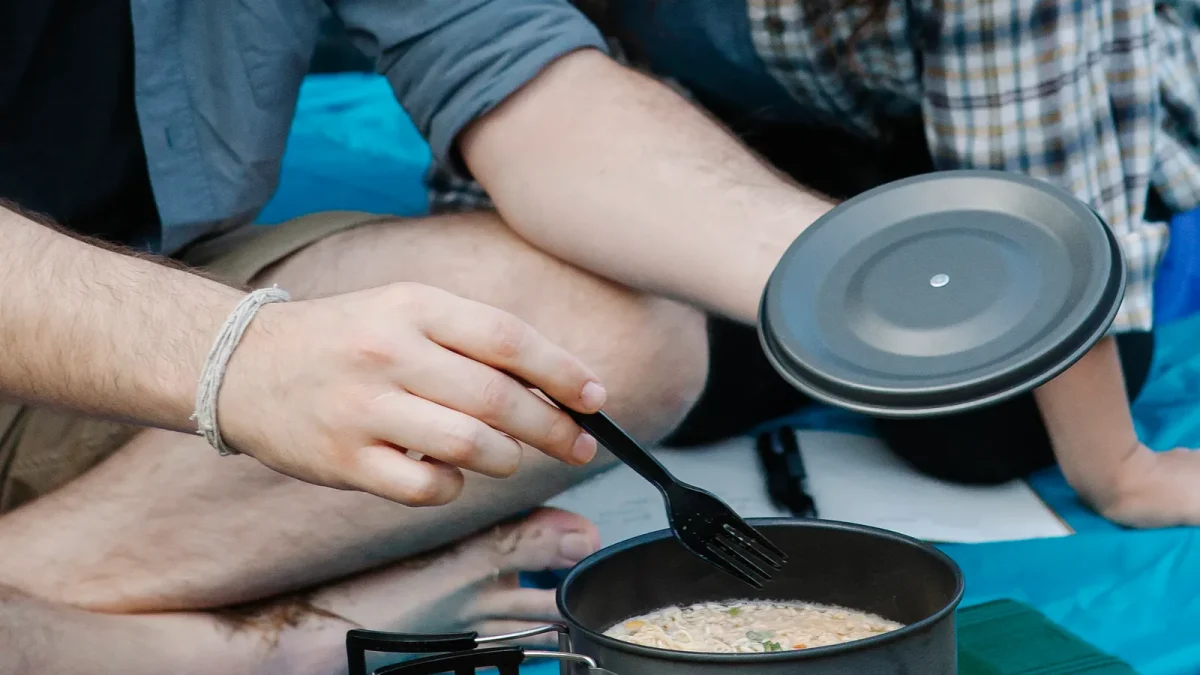
Handles fall into two main styles. Folding wire handles, common on titanium pots like the TOAKS models above, fold flat against the pot for packing and unfold to lift it off the stove. Locking pot handles, like Stanley’s and Sea to Summit’s PIVOT-LOCK design, clamp onto the pot rim and lock in place so it will not slip while you are pouring hot water.
A few things to check before you buy a nesting set:
- Does the stove actually fit inside? Some canister stoves are too tall or wide for a given pot, so check the maker’s own fit notes if you plan to nest a stove.
- Do the handles insulate your hand? Bare metal handles get hot fast; silicone grips or wrapped cork stay cooler to hold.
- Does the lid have a strainer option? It saves carrying a separate strainer for pasta-based meals.
Mugs, Utensils and Small Extras
The pot gets most of the attention, but mugs and utensils decide how comfortable camp meals actually feel. A dedicated mug means you are not eating breakfast out of the same vessel you just boiled water in for coffee.
Insulated mugs, like the ones bundled with the Sea to Summit Alpha set and GSI MicroDualist, keep drinks warmer for longer in cold weather and are safer to hold without a pot cozy or glove. A double-wall design also means less condensation dripping down the outside onto your hands or your sleeping bag.
Some hikers skip a separate mug entirely and use a small titanium pot, like the TOAKS 550ml pot above, as both a cooking vessel and a drinking cup. That saves weight but means you cannot have soup and coffee at the same time without washing up in between.
For utensils, a long-handled spoon or spork is usually all you need. The extra length matters more than it sounds: a short handle means your knuckles end up covered in sauce when you scrape the bottom of a dehydrated meal pouch. Titanium and hard-anodized aluminum utensils both shave weight over steel or plastic camping cutlery, and neither one melts near a hot pot.
🥄 One utensil is usually enough
Most solo and duo backpackers do fine with a single long spoon or spork each. Save the fork, knife and extra spoon for car camping trips, where a full camp kitchen setup makes more sense.
Weight Comparison: What the Makers Say
Numbers make material differences concrete. This table lines up the weight and capacity of every pick above, straight from each brand’s own spec sheet or current Amazon listing, so you can compare grams per liter of capacity at a glance.
| Product | Material | Capacity | Weight (maker’s spec) |
|---|---|---|---|
| TOAKS Titanium 550ml Pot | Titanium | 550 ml | 2.6 oz (72 g) with lid |
| TOAKS Titanium 750ml Pot | Titanium | 750 ml | Lightest per liter 3.6 oz (103 g) with lid |
| TOAKS Titanium 1600ml Pot | Titanium | 1,600 ml | 6.9 oz (194 g) with lid |
| Sea to Summit Alpha Light Long Spoon | Hard-anodized aluminum | — | 0.4 oz (12 g) |
| GSI Outdoors Halulite MicroDualist | Hard-anodized aluminum | 1.4 L pot, full kit | 1 lb 0.7 oz (about 473 g) total kit |
| Sea to Summit Alpha Pot Cook Set 2.2 | Hard-anodized aluminum | 1.2 L + 2.7 L, full kit | About 30.5 oz (865 g) total kit |
| Stanley Adventure 11-Piece Cook Set | Stainless steel | 2.6 qt (2.5 L), full kit | About 1.87 lb (30 oz) total kit |
Notice how the gap grows with material, not just size. The two titanium solo pots weigh a fraction of the full aluminum and steel kits, but those kits also include bowls, mugs and sporks that the titanium pots do not. Compare like with like: a bare pot weight against another bare pot, or a full kit weight against another full kit.
✨ The real question isn’t grams, it’s grams per person fed
A 103 g titanium pot only feeds one person. A 473 g aluminum kit feeds two, with mugs and bowls included. Divide the total kit weight by the number of people it serves before you compare across group sizes.
Common Mistakes (and How to Fix Them)
1. Comparing pot weight without the lid or handle
❌ The mistake: looking at a headline weight that only counts the bare pot, not the lid, handle or included extras.
✅ The fix: check whether the maker’s number includes the lid. We noted this for every pick above so you can compare fairly.
2. Buying titanium for a group that cooks real meals
❌ The mistake: choosing titanium because it is the lightest, then being frustrated when rice burns on the bottom.
✅ The fix: pick hard-anodized aluminum for anything beyond boiling water, and save titanium for solo boil-only trips.
3. Ignoring whether your stove actually fits
❌ The mistake: buying a nesting set without checking if your canister stove and fuel fit inside it.
✅ The fix: measure your stove’s packed height and width, then compare it against the pot’s internal dimensions before you buy.
4. Oversizing the pot for your actual group
❌ The mistake: buying a large group pot for a trip that is usually just you and one friend.
✅ The fix: use the group-size table above, and remember you can always cook in two rounds with a smaller pot.
5. Forgetting a dedicated mug or bowl
❌ The mistake: buying just a bare pot, then realizing at camp there is nothing to eat or drink out of.
✅ The fix: pick a kit that already includes mugs and bowls, or add a lightweight insulated mug separately.
Pro Tips for Backcountry Cooking
These habits come up again and again in outdoor-gear guides and manufacturer advice. None of them cost extra weight, and most of them save fuel.
- Keep the lid on while heating. A closed lid traps heat and cuts your boil time, which means less fuel burned per meal.
- Boil only what you need. Extra water in the pot takes extra fuel and extra minutes to heat, even if you pour some out later.
- Match your pot to your stove’s pot supports. A pot base that is too small or too large for your stove’s arms can tip more easily.
- Add a pot cozy for titanium. A simple insulating sleeve lets food keep cooking after you take a titanium pot off the flame, which helps offset its hot spots.
- Pack fuel and stove inside the pot. Most nesting sets have room for a canister stove and small fuel canister, which saves space elsewhere in your pack.
- Wipe pots out before packing. A quick wipe with a bandana or scraper keeps food residue from attracting animals or making a mess in your pack.
Good backcountry cooking is not about fancy meals. It is about matching simple gear to what you actually plan to eat.
Real-World Cook Kit Setups
These are composite examples built from patterns backpackers commonly share in gear forums, trip reports and online communities. They are not individual testimonials, but they show how different cooking styles lead to different gear choices.
What these three setups have in common: each one matches the cookware to how the person actually cooks, not to what looks lightest on a shelf. The solo hiker’s titanium pot would frustrate the cooking-focused pair, and the pair’s heavier aluminum set would feel like dead weight to the gram-counter. There is no single right answer, only the right pot for your own trip.
Frequently Asked Questions
Is titanium or aluminum better for backpacking cookware?
It depends on what you cook. Titanium is lighter and more expensive, but heats unevenly, so it suits boiling water more than real cooking. Hard-anodized aluminum weighs a bit more but spreads heat evenly, which makes it better for eggs, rice or sauces.
What size pot do I need for backpacking?
A solo hiker who only boils water usually needs 500 to 750 ml. Two people typically want 1 to 1.7 liters. Larger groups do better with two mid-sized pots rather than one very large one, since they boil faster in parallel.
Can you cook real food in a titanium pot?
Yes, but carefully. Titanium’s uneven heat means food near the direct flame can burn while the rest stays undercooked. Many backpackers use titanium mainly for boiling water and stick to hard-anodized aluminum for simmered or fried meals.
Is stainless steel too heavy for backpacking?
It is the heaviest of the three common materials, according to MSR’s own gear guide. That makes it a better fit for short trips, car-adjacent camping or budget-first buyers than for long-distance thru-hikes where every ounce counts.
Do I need a full nesting cook set, or just one pot?
Solo hikers who only boil water usually only need one pot. A nesting set with bowls, mugs and a strainer lid makes more sense for two or more people who want to cook, eat and clean up without extra separate gear.
Your Backpacking Cookware Checklist
Work through this list before you buy or pack your cook kit. Start with your group size and cooking style, then let material and extras follow from there.
Tap each item as you complete it. Your progress is saved in this browser.
- Decide your group size: solo, two, or a small group
- Decide if you mostly boil water or cook real meals
- Pick a material: titanium for boil-only weight savings, aluminum for even-heat cooking, steel for budget and toughness
- Match pot capacity to the group-size table above
- Check that your stove and fuel canister actually fit inside, if you want to nest them
- Confirm the lid seals well and, ideally, doubles as a strainer
- Add a mug or bowl if your chosen pot does not include one
- Pick one long-handled utensil per person
- Compare full-kit weight to full-kit weight, not bare pot to bare pot
The Bottom Line
The best backpacking cookware is not one single product. It is the material and size that matches your group and your cooking style. Solo hikers who boil water do best with a small titanium pot. Pairs who cook real meals do best with a hard-anodized aluminum nesting set. Budget-first campers and small groups on short trips can lean on stainless steel.
Start with your group size, be honest about how you actually cook, then use the tables above to compare real weights and specs before you buy.
🎒 Plan your full cook kit
Use our free tools to round out your gear list and keep your pack weight in check.
🎒 Gear Planner ⚖️ Pack Weight Calculator ✅ Checklist Generator
Keep reading: complete stove-and-pot cook systems, the best camp cookware for car camping and our campfire cooking tripod guide.
Sources
- MSR / Cascade Designs: Backpacking Cookware 101, Titanium vs. Aluminum vs. Stainless Steel
- TOAKS Outdoor: Titanium 750ml Pot specifications
- TOAKS Outdoor: Titanium 1600ml Pot specifications
- TOAKS Outdoor: Ultralight Titanium 550ml Pot specifications
- GSI Outdoors: Halulite MicroDualist specifications
- Cool of the Wild: Sea to Summit Alpha Pot Set 2.2 review and specs
- Adventure Alan: Sea to Summit Alpha Light Long Spoon specifications
Facts checked in September 2026. Specs and availability change, so confirm details on the maker’s page before you buy.
You may also like
Best Camping Tent Brands: How the Top Names Compare (2026)
Not all tent brands are alike. See what Big Agnes, MSR, NEMO, Coleman, Kelty and REI Co-op each do best, their price…
Best Pocket Knife for Self-Defense? An Honest 2026 Guide
A pocket knife is a poor, legally risky choice for self-defense. Here's why, plus the safer options we recommend first and six…
Are Timberlands Good for Hiking? A Comprehensive Review (2026)
Timberland sells real hiking boots and a classic work boot under one name. Here's an honest, spec-based look at which models handle…

Get better at hiking.
Practical hiking tips, gear guides, trail advice and outdoor stories, delivered occasionally. No spam, unsubscribe any time.